Copied trash can design: a manufacturer wins its case and loses one of its own designs
1,014 street litter bins. That is how many copies of its design a street furniture manufacturer saw installed across a French metropolitan area after losing the corresponding call for tenders. On October 20, 2026, the Bordeaux Court of Appeal ruled in its favor: design infringement, copyright infringement, and €170,000 in damages1. Yet the same judgment upholds the invalidation of one of its two registered designs.
The case matters to anyone who designs functional products, especially products sold through public tenders: street furniture, roadway equipment, playgrounds, signage.
Can a utilitarian object be protected?
Yes. The French Intellectual Property Code protects, as a design, the appearance of a product, defined in particular by its lines, contours, shape, or materials2. The design must be new and have individual character: it must produce on the informed user an overall visual impression that differs from that of previously disclosed designs3.
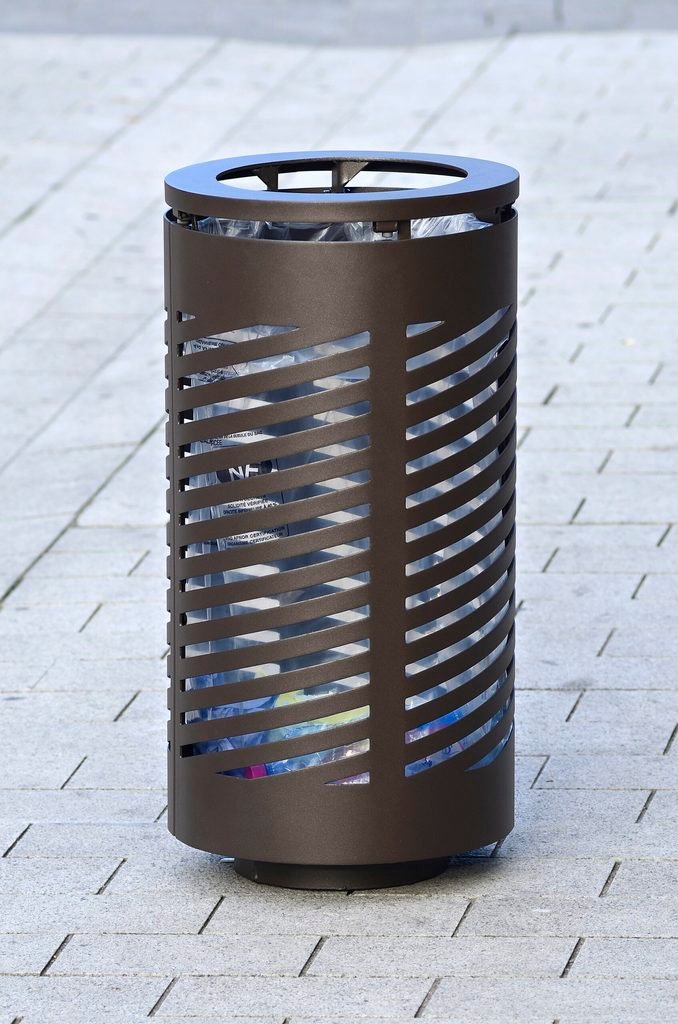
Function stands in the way of protection only to a limited extent. The only features excluded are those solely dictated by the product’s technical function4. A street litter bin must have an opening at the top, perforated walls so that its contents remain visible, and a hoop to hold the bag. No one can claim exclusive rights in these elements.
The court found, however, that the helical shape created by diagonal cutouts, the recess under the lid, and the hexagonal shape of the hoop are independent of these constraints5. The design registered in 2011, and duly renewed since, is therefore valid. In a sector where the designer’s freedom is limited, protection remains; the informed user simply pays closer attention to details.
Selling before filing puts the design at risk of invalidation
In 2019, the manufacturer had registered a second design: the same bin, with a wider opening and a cigarette snuffer on the lid. The defendant produced invoices issued by the manufacturer itself between June 2017 and September 2019. The snuffer version had therefore been on sale two years before it was filed.
Novelty is assessed as of the filing date. The Code provides a grace period: a disclosure made by the designer is disregarded if it took place within the twelve months preceding the filing6. Beyond that period, the owner’s own product becomes prior art that can be invoked against its own filing. The 2019 design was invalidated, and the infringement claim based on that design was dismissed7.
Companies often update a product, show it at a trade fair, or deliver it to a first customer, and only think about filing the day a copy appears, or when the legal department belatedly learns that the new product has been launched. Yet the twelve-month period starts running from the first time the product is made available to the public, in whatever form.
“Or equivalent”: wording that does not authorize copying
The metropolitan authority’s specifications described the required bin by citing the manufacturer’s model, followed by the words “or equivalent.” The competitor argued that the similarities had been imposed on it by the public buyer. The court rejected the argument: the technical specifications of the contract left room for creative freedom, and the words “or equivalent” did not require an identical design.
The lesson applies to both sides. A bidder responding to a call for tenders must offer a product that is functionally equivalent, without copying the appearance of the reference product. The manufacturer cited as the reference, for its part, can take action if a competitor wins the contract with a copy.
Copyright as a second line of defense
The manufacturer also relied on copyright, which can indeed be invoked to protect works of applied art as well8. The two forms of protection are cumulative, but each has its own criteria: novelty and individual character for the design, originality for the work. And the harm can be compensated only once when both grounds are invoked for the same acts.
On ownership, case law presumes, with respect to a third party sued for infringement and absent any claim by the author, that the legal entity exploiting the work under its own name holds the rights9. On originality, a statement from the former production manager who had designed the bin, together with his drawings, established arbitrary choices: a suspended effect, wave-shaped cutouts, a snuffer decorated with a glowing cigarette. The bin was held to be original, and copyright infringement was found10.
In other words, had the design expired or failed to meet the criteria for protection, copyright could have come to the rescue of the victim of the infringement.
A lower price is not necessarily wrongful
The manufacturer further accused its competitor of unfair competition: lower prices, unrealistic delivery times, lower-quality products. A standalone unfair competition claim requires facts distinct from the acts of infringement. Price and quality, moreover, had already been raised in support of the non-material harm caused by the infringement.
As to price, absent evidence of an abnormally low price or below-cost sales, freedom of trade allows a company to undercut its rivals. As to the two-week lead time announced in the bid, it was not met, but nothing showed that the competitor knew this when it bid, and that criterion accounted for only 30% of the score. The claim was dismissed.
That said, a price lower than that of the imitated competitor is frequently relied on to establish the plaintiff’s economic harm.
What is a copy worth in a public procurement contract?
The court must separately consider the right holder’s lost profits, its non-material harm, and the infringer’s profits11. The manufacturer sought more than €400,000. The court awarded12:
- The margin the right holder would have earned on the 1,014 bins, reduced by half: it had not been awarded the contract, other companies had bid, and nothing proved that it would have won
- The savings the infringer made by having the copy manufactured at a lower cost, converted into an estimated profit
- Non-material harm, since the cheaper copy had trivialized a bin listed with the metropolitan authority
In total, €160,000 for material harm and €10,000 for non-material harm, plus no less than €10,000 in legal costs on appeal.
In practice: a few tips
- File before the first public presentation, or at the latest within twelve months
- File each visible update of a product, and renew older designs that are still on the market
- Keep dated preparatory drawings and make sure you know who their author is
- Archive invoices and catalogs: they prove use, but they can also backfire against a late filing
- Read carefully any specifications that cite a product “or equivalent”
- Document your harm from the outset: in a tender, you will have to show that you had a chance of winning
LAZULI advises companies that design street furniture, particularly for public buyers, on registering their designs in France and the European Union, auditing their creations before they go to market, and taking action against copies, including when they surface in connection with a public procurement contract.
Jérémie LEROY-RINGUET, November 2026
- Bordeaux Court of Appeal, 1st civil chamber, October 20, 2026, RG No. 24/00125, affirming Bordeaux Judicial Court, December 19, 2023 ↩︎
- Article L. 511-1 of the French Intellectual Property Code ↩︎
- Articles L. 511-3 and L. 511-4 of the French Intellectual Property Code ↩︎
- Article L. 511-8, 1° of the French Intellectual Property Code ↩︎
- Bordeaux Court of Appeal, October 20, 2026, supra, §§ 19–22 ↩︎
- Article L. 511-6 of the French Intellectual Property Code ↩︎
- Bordeaux Court of Appeal, October 20, 2026, supra, §§ 23–26 ↩︎
- Article L. 112-2, 10° of the French Intellectual Property Code ↩︎
- Cass. 1st civ., March 24, 1993, No. 91-16.543, Bull. civ. I, No. 126 ↩︎
- Bordeaux Court of Appeal, October 20, 2026, supra, §§ 37–47 ↩︎
- Article L. 521-7 of the French Intellectual Property Code ↩︎
- Bordeaux Court of Appeal, October 20, 2026, supra, §§ 65–76 ↩︎