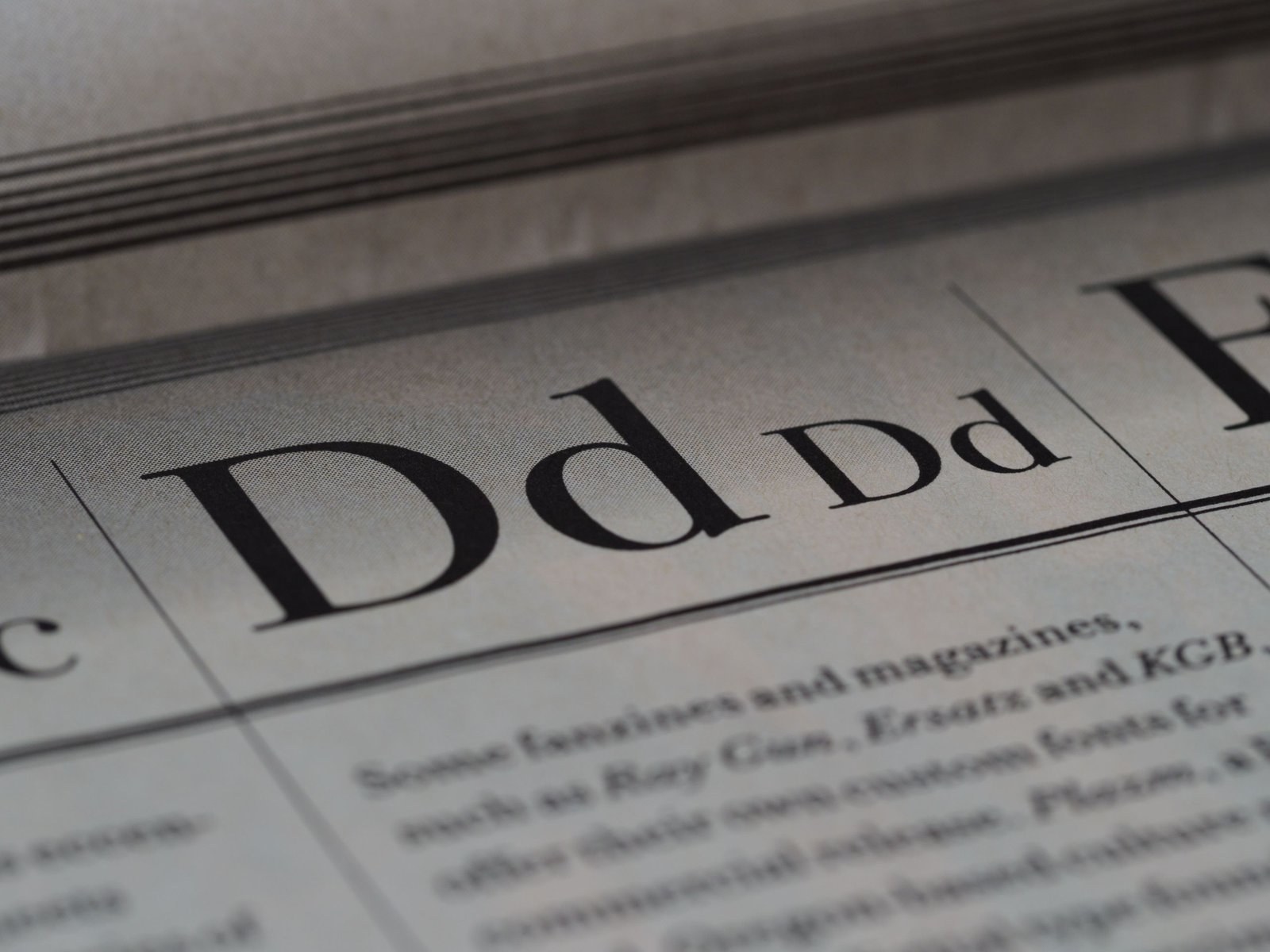
This free font could cost you dearly
The logo has been signed off. It was put together in one evening, using a font found on a download site — free, “free for personal use”. It now appears on the labels, the website and the social media accounts, and it has just been filed as a trade mark. Two years later, a letter arrives: the font’s designer wants answers.
A court ruled on this very scenario in September 2025, but it arises above all before litigation begins, rights holders being generally keen to monitor unauthorised uses of their works.
A typeface is a protectable work
The French Intellectual Property Code says so expressly: works of the mind include “graphic and typographic works”. A typeface — the full set of letters, figures and signs drawn in a single style — is therefore protected by copyright from the moment it is created, with no registration required, on one condition: it must be “original”, that is, it must bear the imprint of its author’s personality1.
That condition has to be demonstrated. The designer must be able to explain the choices that carry the imprint of his or her personality: the weight of the stems, the drawing of the serifs, the rhythm of the curves, the contrast between thick and thin strokes. Whatever belongs to the common stock of typography cannot be appropriated. A classical roman or a featureless sans serif will support no monopoly; a font drawn with an identifiable design intent will.
The Cour de cassation has also held that originality is assessed by reference to the combination of all the elements, not to each of them taken in isolation: a court of appeal that had refused protection to record sleeves on the ground that “the typography is commonplace” was reversed. The banality of one element does not exclude the originality of the whole2.
Free does not mean unrestricted
The major font download sites display a licence notice for each font: “100% free”, “free for personal use”, “donationware”, “demo”. Those notices are contractual. “Free for personal use” allows a font to be used to make a birthday card or a menu for a family celebration. It authorises neither the creation of a logo intended for commercial use, nor that of packaging, an online shop or an advertising campaign.
The rule is straightforward: any reproduction of a work without the consent of its author or of the rights holder is unlawful. For a font, that consent takes the form of a font licence. The licence sets the number of permitted workstations, use on the web (a separate “webfont” licence), embedding in a logo (often a specific option), and the prohibition on modifying the glyphs or redistributing the file. Whether the price is nil or not changes nothing: you do not acquire the font, you obtain a defined authorisation to use it3.
My clients are often surprised to learn that the graphic designer who composed their logo has not necessarily dealt with this question. The assignment of rights in the logo, where there is one, covers only the designer’s own work. It does not cover a third party’s font that he or she used.
What the Nanterre court recently held
The case is telling. A designer working under a pseudonym released on a download site a horror-style font, “Lethal Slime”, free for personal use, with an invitation to contact him for any commercial use. Two companies selling children’s hair-care products used that font in the logo of a range of shampoos. The logo was filed as a trade mark, applied to the bottles and distributed on retail websites, on social media and through a mobile application.
The companies disputed everything: a font is produced with software, without creative effort; the dripping style is widespread; the author does not prove that he drew the letters by hand. The court did not follow them. The author had described his design intent precisely: a viscous, dripping appearance giving relief and movement, twisting and irregular outlines, proportions calculated to add weight, a black outline and a white interior accentuating the relief effect. A scanned drawing board still bearing pencil marks established that the work had been created by hand. The font was held to be original4.
On infringement, the reasoning fits into a single sentence: the download page stated that the font was free for personal use and invited users to contact the author for commercial use, so that “discussions had to be entered into with the author of that font, with a view to obtaining a licence to use it”. Commercial use without a licence amounts to infringement. The court also found a breach of moral rights: the font had been used without any mention of the author’s name, in breach of his right of attribution5.
The damages awarded fell far short of the claim: 7,000 euros in total, of which 6,000 for economic loss and 1,000 for the breach of moral rights, against the 60,000 euros the author had sought. The reason: he had failed to establish the extent of the infringing volume. The lesson cuts both ways. For a business, liability is established as soon as the licence is missing. For a creator, compensation has to be prepared with quantified evidence.
A font file is also software
A modern font comes as an .otf, .ttf or .woff file. That file contains far more than drawings: tables, display instructions, code. It is generally analysed as software and protected as such by copyright6.
The consequence is that even a font whose drawing would be held commonplace remains a file whose unauthorised copying can be actioned: installation on every workstation in an agency under a single-seat licence, sending the file to the client, embedding it in a website without a webfont licence. Two objects, two authorisations. How far the file itself is protected is still debated case by case, which calls for caution.
What remains permitted
The letter A belongs to no one. Nor does a style: gothic, script, stencil, “dripping”. The NANTERRE court made the point: the description of the combination claimed must be “sufficiently precise to confine the monopoly sought to a defined combination enforceable against all, without extending it to a genre incapable of appropriation”7.
Drawing inspiration from a style in order to design your own font is therefore lawful. Tracing the glyphs of an existing font, vectorising them and renaming them is not. Between the two, the line is drawn on the similarities: they are what counts, not the differences added to cover the tracks.
Three habits worth adopting
Before composing a logo: read the font licence and keep it with the trade mark creation file. If the licence excludes commercial use or use in a logo, buy the appropriate licence or change font.
When commissioning a logo: ask the graphic designer which font was used and under which licence, and set out that information in the assignment agreement, together with a warranty clause.
When designing fonts: document the creative process (sketches, drawing boards, dated versions), describe the aesthetic intent in writing, and keep evidence of downloads and of any commercial uses identified, in particular in order to quantify the loss.
LAZULI advises font designers, design studios, and the individuals, professionals and companies building their visual identity: auditing font licences before a trade mark filing, drafting assignments of rights with graphic designers, filing designs and trade marks, cease-and-desist letters and infringement actions.
Jérémie LEROY-RINGUET, September 2026
- Article L. 112-2, 8° of the French Intellectual Property Code ↩︎
- Cass. 1re civ., 10 April 2019, no. 18-13.612, unpublished: “Qu’en se déterminant ainsi, par des motifs impropres à exclure l’originalité des pochettes revendiquée, laquelle doit être appréciée dans son ensemble au regard de la combinaison des différents éléments, même banals, les composant, la cour d’appel n’a pas donné de base légale à sa décision” ↩︎
- Article L. 122-4 of the French Intellectual Property Code ↩︎
- TJ Nanterre, 10 September 2025, case no. 23/04144 ↩︎
- Article L. 121-1 of the French Intellectual Property Code ↩︎
- Article L. 112-2, 13° of the French Intellectual Property Code ↩︎
- TJ Nanterre, 10 September 2025, cited above ↩︎