Copied Jewelry: Why the Clover Wins and the Stackable Ring Loses
“I designed it, so it’s protected.” Many jewelry designers take this reasoning for granted. It is only half right. Copyright does arise without registration or any other formality. But the day a copy appears, it is up to the designer to show what is original about the piece, and the court may well answer that it belongs to nothing more than the common heritage of jewelry design.
Two 2026 decisions illustrate this strikingly. In Marseille, the four-lobed clover motif of a major Place Vendôme jewelry house was held to be protected, and its copying was heavily sanctioned. In Paris, a designer of stackable rings lost on every ground, even though her designs were registered with the INPI (the French Intellectual Property Office). The difference lies in the shape of each piece and, above all, in the evidence.
A Piece of Jewelry Can Be a Work of Authorship Protected by Copyright
The French Intellectual Property Code expressly lists among works of authorship “works of applied art” and “creations of the seasonal industries of clothing and adornment.”1 A piece of jewelry can therefore be protected by copyright by the mere fact of its creation, without any registration formality.2
The condition for protection is originality: the piece must reflect its author’s personality through free and creative choices. The Court of Justice of the European Union reaffirmed this with respect to utilitarian creations: only originality matters, not the aesthetic effect produced by the object.3 A lovely but commonplace piece will not be protected; a discreet piece that reflects personal choices may be.
The Clover: A Combination Described and Defended
On January 8, 2026, the Marseille Judicial Court ruled on the sale, by a retailer and her company, of 190 pieces of jewelry reproducing the Alhambra motif of Van Cleef & Arpels.4
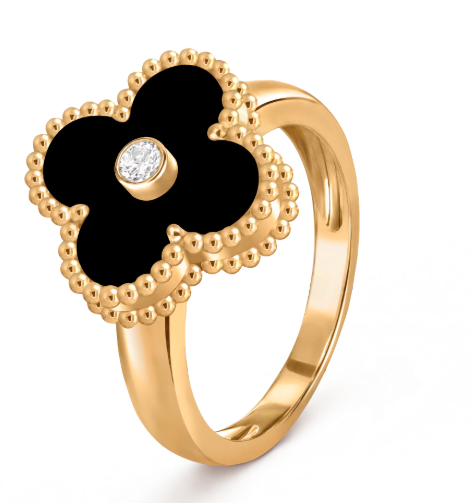
The rights holder did not merely rely on the fame of its motif. It described its precise combination: four symmetrical semicircular lobes forming a stylized clover, a beaded precious-metal rim encircling the stone, and the choice of hard stones contrasting with the gold. The court held that the motif’s originality “lies in the combination of the elements that characterize them according to particular arrangements, and only in that combination.”
Crucially, the court noted, the defendant “provides no serious demonstration” that these elements belonged to the common heritage of jewelry making. The court therefore rejected the argument that the house was claiming a monopoly over the clover shape in general.
The sanctions are heavy: a sales ban subject to a daily penalty, destruction of inventory, publication of the judgment in three newspapers or magazines, €50,000 in damages for copyright infringement, and a further €50,000 to the exclusive distributor for unfair competition and free-riding. The judgment has been appealed.
The Stackable Ring: A Concept and a Common Heritage
On July 9, 2026, the Paris Judicial Court reached the opposite result regarding rings made of two to six soldered bands, partly paved with diamonds, designed to be stacked and worn either way round.5
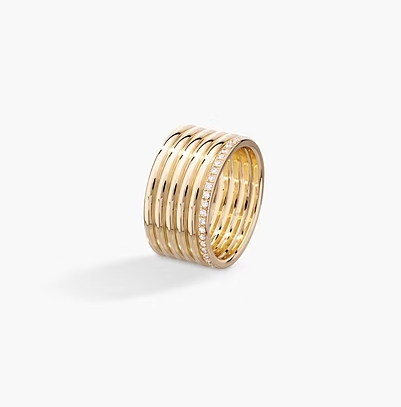
The designer first relied on the principle of stacking and on the reversibility of her rings. The court responded that this was “a mere concept that falls outside the scope of copyright protection, which protects only the form in which an idea is expressed and not the idea itself.”
That left the shape itself. The defendants had produced earlier rings by other houses: multiple paved bands, alternating paved and polished bands, an ornate central body framed by smooth ends. None reproduced all the features of the claimed rings, but each displayed some of them. For the court, these features belong to “a common heritage already explored by other jewelry houses,” and their combination, “even if novel in its overall result,” does not reflect its author’s personality.
In both cases, the court reasoned on a combination of features. In Marseille, the defense put forward nothing serious. In Paris, it assembled a precise prior-art file, and that file carried the day.
The Registered Design: An Effective IP Right, but Not an Invincible One
The designer had taken the precaution of registering her rings as designs with the INPI. That precaution paid off on one point: the court held the designs to be new and to have individual character, and dismissed the claim for invalidity.
But a valid design does not guarantee a finding of infringement. Protection extends only to products that do not produce a different overall visual impression on the informed user.6 The competing rings, however, featured diamond paving on the edge of the band, absent from the registered designs, and the court held that this difference altered the overall impression. It added that any underhanded means by which the competitor may have gained access to the designs were irrelevant: design infringement is assessed objectively, regardless of good or bad faith.
The unfair competition and free-riding claims were dismissed as well. The terms “fine jewelry” and “stacking” were held to be descriptive, and 18-karat gold and an offering in three golds were found to be industry standards. The designer and her company were ordered to pay €8,000 to each of the two defendants in legal costs.
An Appeal Does Not Suspend the Obligation to Comply with the Judgment
Since 2020, first-instance judgments have, as a rule, been enforceable as soon as they are handed down, even if appealed.7 The losing party may ask the First President of the Court of Appeal to stay enforcement, but it must show a serious ground for reversal and manifestly excessive consequences.8
The company found liable in Marseille tried this route. In an order dated October 22, 2026, the Aix-en-Provence Court of Appeal dismissed its application.9 Manifestly excessive consequences require “an irreversible situation of exceptional gravity” or an “irremediable financial peril.” The company produced no evidence of the share of these pieces in its business or of its financial situation. The sales ban and the destruction of inventory will therefore apply for the entire duration of the appeal proceedings.
Four Precautions to Protect a Jewelry Collection
- Document every creation: dated sketches, design files, exchanges with the workshop. These records prove the date and the creative process
- Carefully describe what makes the piece distinctive: the precise combination of its features, not the idea or trend it illustrates
- Register the most important designs no later than twelve months after their first disclosure to the public,10 and check the prior art on the market before taking legal action
- Quickly gather evidence of the copying (bailiff’s report of a test purchase, infringement seizure)
These two cases share a common lesson. With jewelry, an infringement case is won on a precise description of the shape and on a prior analysis of the state of the market at the time of creation, far more than on the designer’s reputation or the success of the copied piece.
LAZULI assists jewelry designers, fine jewelers, and costume jewelry brands in protecting their collections: analysis of originality and prior art, design registrations, evidence gathering, infringement actions, and defense against allegations of copying.
Jérémie LEROY-RINGUET, November 2026
- French Intellectual Property Code (CPI), art. L. 112-2, 10° and 14° ↩︎
- CPI, art. L. 111-1 ↩︎
- CJEU, September 12, 2019, Cofemel, Case C-683/17 ↩︎
- Marseille Judicial Court, 1st civ. ch., January 8, 2026, RG No. 24/12573 ↩︎
- Paris Judicial Court, 3rd ch., 1st sect., July 9, 2026, RG No. 23/13320 ↩︎
- CPI, art. L. 513-5 ↩︎
- French Code of Civil Procedure (CPC), art. 514 ↩︎
- CPC, art. 514-3 ↩︎
- Aix-en-Provence Court of Appeal, ch. 1-11 summary proceedings, order of October 22, 2026, RG No. 26/00340 ↩︎
- CPI, art. L. 511-6 ↩︎