Who owns your tatoo?
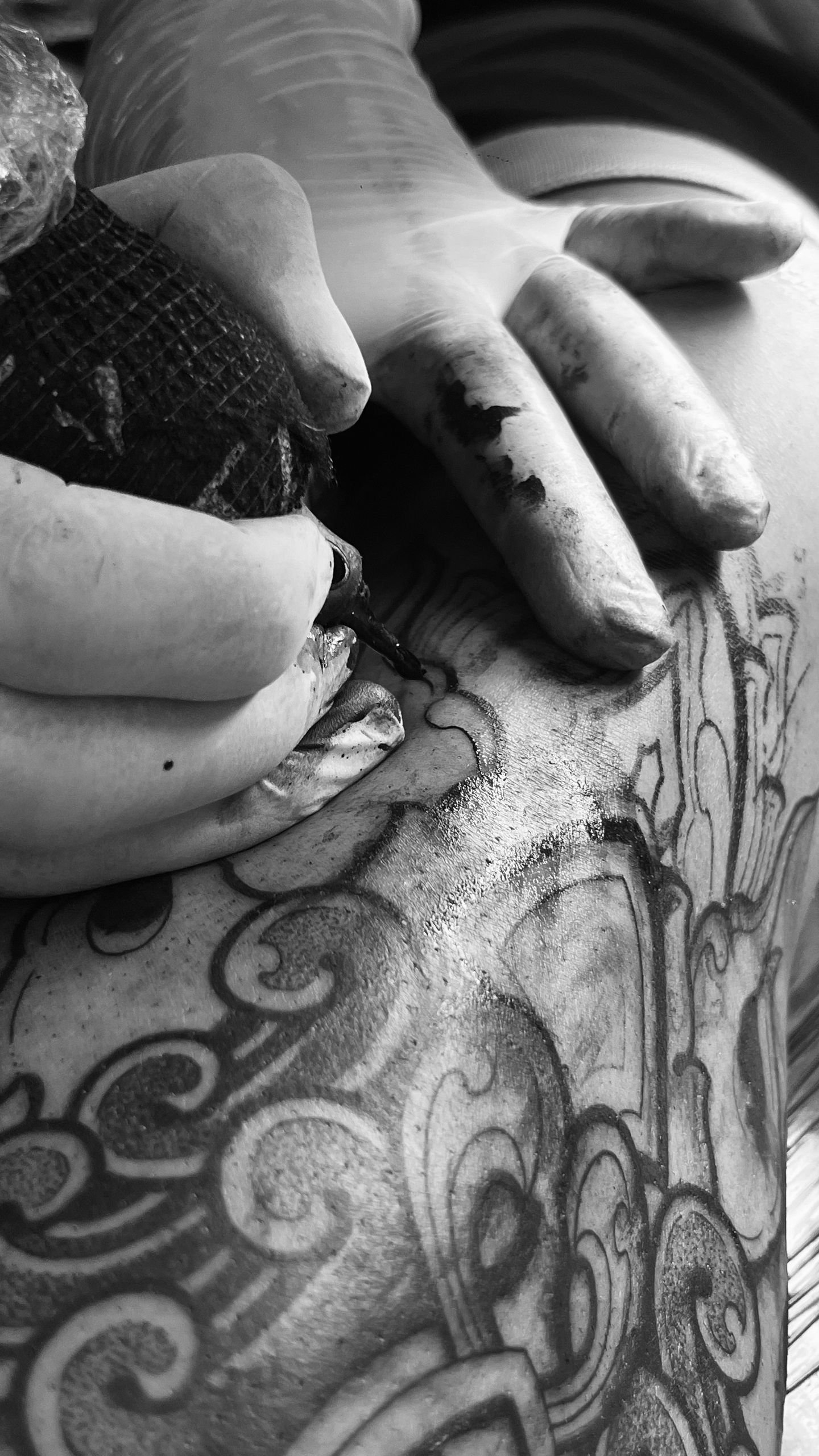
A shoot in Pantin, a bare-chested model, and on his shoulder a design inked three years earlier by a tattoo artist from the 20th arrondissement of Paris. The brand had the model sign an image-rights release, the agency paid, and the campaign is due out in November on bus shelters and on Instagram. Six weeks later, stepping out of the métro, the tattoo artist recognises his design.
He calls a lawyer. His question fits in a single sentence: do I have a say? The answer is yes.
A tattoo is a drawing, and therefore a protectable work of the mind
The French Intellectual Property Code protects works of the mind whatever their kind, form of expression, merit or purpose (Article L. 112-1). Article L. 112-2 lists, at point 7, works of drawing. Neither provision concerns itself with the medium of the work: paper, canvas and skin go equally unmentioned.
The only condition for protection is originality, which is assessed in light of the imprint of the author’s personality perceptible in the work. Artistic quality, the “merit” of the work, does not come into it.
The Johnny Hallyday tattoo case
The tattoo artist’s question is anything but theoretical: the French courts have already answered it. The tattoo artist Santiag had drawn an eagle’s head on the singer’s arm and filed his drawing with the INPI in November 1992 (as a “design”, not to protect his copyright: no formality is required for a work of the mind to be protected). The design became an emblem: the record company reproduced it, with alterations, on record sleeves, promotional material and tee-shirts.
In 1996, the Paris tribunal de grande instance found an infringement of the author’s right of attribution and right to the integrity of his work, and rejected the argument based on the singer’s personality rights, which would have made him the owner of the drawing. The Paris Court of Appeal upheld the ruling on 3 July 1998: admittedly, the tattoo had become an attribute of the artist’s personality, which authorised the use of photographs in which it appeared only incidentally; but reproducing the drawing itself required its author’s consent, the singer having no rights to assign on that score.
The decision is an old one. It has never been called into question, and it lays down two rules: the tattoo artist retains the rights in his drawing in the absence of a formal assignment agreement, and the tattooed person remains free to exploit his or her own image so long as the design is not the main subject of the photograph.
Your body belongs to you, but your tattoo does not
Article L. 111-3 of the Intellectual Property Code provides that intangible property is independent of ownership of the physical object, and that acquiring that object confers none of the rights provided for by the Code.
In other words: buying a painting does not entitle you to print it on postcards. Wearing a tattoo does not entitle you to authorise the reproduction of the design either.
Paying is not acquiring
The tattoo artist’s invoice, by itself, is no assignment of rights either. Article L. 131-3 makes the transfer of author’s rights conditional on each assigned right being separately mentioned in the instrument, and on the scope of exploitation being delimited as to its extent, purpose, place and duration.
So when a brand wants to publish the image of a tattoo, it has two authorisations to secure: that of the person, for their image rights, and that of the tattoo’s author, for the reproduction of the drawing.
And of course, if the tattoo artist merely reproduced a drawing or a pre-existing work of which he is not the author (a film or comic-book character, for instance), the authorisation of that work’s author or rightholder is also required.
Where the tattoo appears only incidentally, no rights need be assigned
The criterion of incidental versus principal representation, adopted in 1998, is the one the Cour de cassation applies in other areas of copyright law. Ruling on postcards depicting the Place des Terreaux in Lyon, it held that the work of the square’s designers blended into the architectural ensemble of which it was merely one element, so that its presentation was incidental to the subject matter and did not amount to a communication of the work to the public1.
Transposed to tattoos, this doctrine of incidental use teaches that a distant figure in a wide shot does not raise the same issue as a close-up on a shoulder chosen for its artwork. The line is crossed as soon as the drawing becomes the very subject of the image, photographed or filmed, and no longer the mere backdrop of the scene.
The body is not a canvas like any other
An older case, also about a tattoo, is a reminder of the limit the law places on contracts over the human body. A seventeen-year-old girl had been hired for a scene in the film Paris Secret. The contract provided that she would be tattooed, that the tattoo would be removed a fortnight later by a surgeon, and that the excised design would become the property of the production company. The contract was performed, and the actress was left with a sizeable scar.
Having come of age, she went to court. On 3 June 1969, the Paris tribunal de grande instance annulled the contract as unlawful, immoral and contrary to public policy, restoration being impossible. The Paris Court of Appeal upheld the judgment on 16 March 1970, and the Cour de cassation dismissed the appeal on 23 February 19722, approving the lower courts for finding personal fault on the part of the production manager who had signed up a minor under immoral and unlawful conditions.
The lesson outlives its era: a tattoo may be a work of authorship, but the skin that carries it is not a tradeable asset.
Admittedly, the contemporary artist Wim Delvoye is known for having tattooed the back of one Tim Steiner and for having contractually bound the model to take part in exhibitions where his back is displayed3. The work is meant to be removed from his body upon his death and returned to the artist. But that contract is not governed by French law, and is therefore not subject to the rules I have just set out.
Moral rights put to the test of the body
Article L. 121-1 gives the author the right to the integrity of his work. That right is perpetual, inalienable and imprescriptible. On a canvas, the rule is easily handled. On skin, it runs into a principle that resists it: no one may be prevented from disposing of his own body.
What happens if the client has the design retouched by another professional, covers it with a cover-up, or has it removed by laser? The published decisions deal with the reproduction of the drawing, never with its physical fate. But moral rights must in all likelihood yield to the tattooed person’s bodily integrity and personal freedom, provided that the owner of the medium makes sure the author holds photographs preserving the work for posterity (by analogy with the case law that allows, in certain circumstances, the destruction of architectural works where their authors were able to document their creation beforehand). The real difficulty lies elsewhere: in the images taken of the tattoo and in their commercial exploitation.
And when the body is scanned?
The question is now shifting to digitised bodies. A player scanned for a sports video game, an actor’s digital double, an avatar sold online: the design is reproduced identically on a medium that is no longer corporeal at all, and the doctrine of incidental use becomes hard to argue when the camera circles the character and zooms in on the tattoo. The same statutes apply, with economic stakes out of all proportion to those of a mere advertising poster.
Whether it is a poster or an avatar, a tattoo artist whose design is exploited without his consent may demand that its distribution cease and claim compensation for his loss.
The tattooed person’s image belongs to the tattooed person
A tattoo artist photographs his work and posts it online, most often on Instagram, sometimes with a face or an identifiable part of the body in the frame. Article 9 of the French Civil Code protects private life, and the courts have derived from it everyone’s right to their own image. Being the author of the drawing does not dispense with obtaining the consent of the person photographed if they are identifiable in the post.
A work of authorship under copyright law, but a supply of services for the tax authorities
The administrative courts deny tattoo artists the reduced VAT rate applicable to supplies of works of art by their author: the human body is not a medium capable of giving rise to a supply of goods, so that making a tattoo is a supply of services subject to the standard rate, even though tattoos may well qualify as works of art4. The tax courts therefore do not dispute the qualification as a work: it is the regime of the transaction that differs, for want of goods supplied.
In short, the points to watch for each party
For the tattoo artist: a written document, handed over before the session, distinguishing what the client may do freely (photograph themselves, publish their own pictures, appear in a campaign where the design remains incidental) from what requires prior consent (exploitation of the drawing as such, on clothing, posters, merchandise, a video game). And, symmetrically, an image-rights release for the tattoo artist’s own publications.
For the brand or agency: a clause in the modelling contract on visible tattoos, with a duty to declare identifiable designs, and a trail back to their author whenever the campaign showcases them.
For the tattooed person: ask the question at the appointment. What they may do with the image of their own tattoo can be settled in two lines before the session.
The subject may seem anecdotal. It is not: not for a tattoo studio whose designs circulate without its consent, not for a brand committing a campaign budget, not for an athlete whose body is filmed every week. French law ruled on the question earlier than one might think, and it did so, as almost always, in favour of the author’s interests. What is missing is not the rule of law, but the two pages of contract that almost no one drafts.
LAZULI advises tattooed clients, tattoo artists and studios on drafting their contractual documents and defending their creations, as well as brands, agencies and producers who need to secure a campaign or a shoot before release.
Jérémie LEROY-RINGUET, August 2026
- Cass. 1re civ., 15 March 2005, no. 03-14.820, published in the Bulletin ↩︎
- Cass. 1re civ., 23 February 1972, no. 70-12.490, published in the Bulletin ↩︎
- https://www.lemonde.fr/m-le-mag/article/2021/03/28/une-peau-a-150-000-euros-l-histoire-vraie-d-un-pacte-faustien-entre-un-artiste-et-son-cobaye_6074712_4500055.html ↩︎
- CAA Douai, 31 March 2011, no. 10DA00487; CAA Lyon, 24 May 2011, no. 10LY01792 ↩︎